Challenge(s)
How can a reason to go and attract more people to an underused area of the port city interface be created by leveraging water as a driver of urban life?
Good practice
Unlocking recreational potential in underused waterfronts can be done through clearly defined, temporary pilot zones combined with a dual-track strategy: continuously improving the testing facility while simultaneously preparing the pathway toward a permanent solution.
This approach is grounded in bottom-up engagement, where small-scale interventions and strong local stakeholder ownership serve as the primary drivers for long-term transformation and institutional support.
A short timeframe from idea to execution is crucial to keep local actors closely engaged in the process and to create visible results that strengthen mobilisation and local ownership. This methodology was tested in the recreational harbour of Sydhavnen.
Case study
The Connected River project is an EU-funded project that aims to boost the capacities of multi-stakeholder ecosystems to deliver services that guarantee the safety, accessibility, and liveability of waterways & waterfronts in the North Sea Region. One of the experiments was led by the municipality of Vordingborg and called the “Social Sauna”.
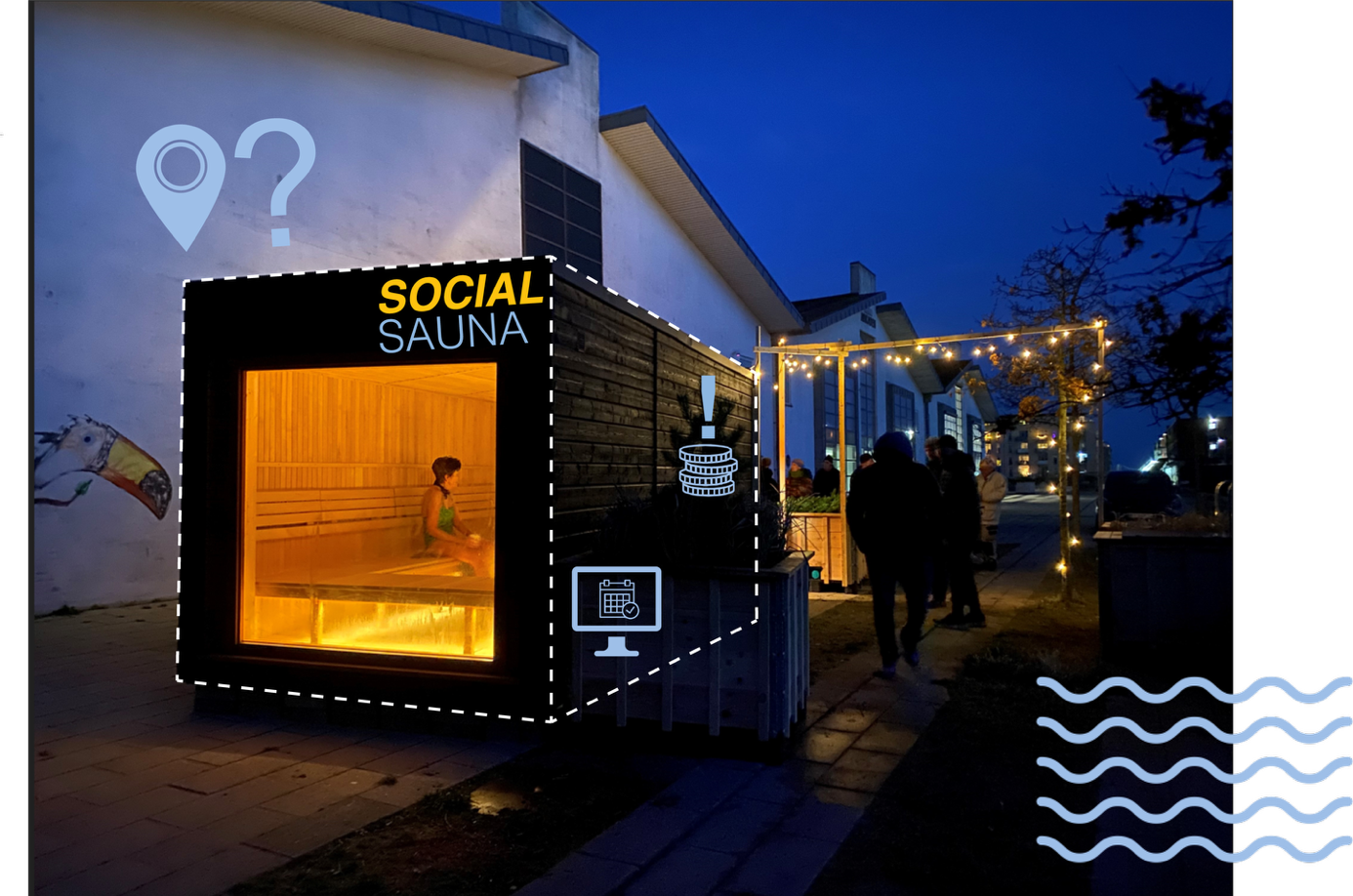
The Social Sauna is an experiment created in close collaboration between the municipality of Vordingborg and the local stakeholders around Sydhavnen, with the aim of bringing new attention, more activities and better accessibility to the attractive waterways and waterfronts in the south of the city of Vordingborg.
The area used to be a large industrial harbour but was transformed into a residential and recreational area many years ago , with new apartment buildings and public urban spaces along the waterfront. Unfortunately, the development of the area stagnated after the financial crisis of 2008 and has not been reactivated since.
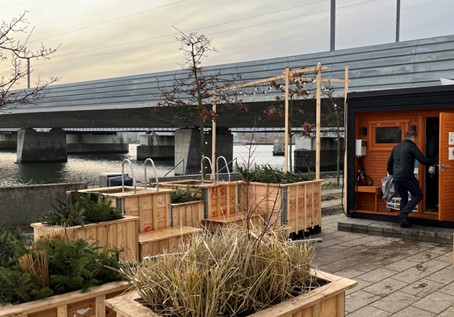
At the start of the experiment, the municipality defined the shared interests, challenges and possibilities and agreed on a set of values for the area, which resulted in designing and building a temporary urban space with plants and a sauna, called the “Social Sauna”.
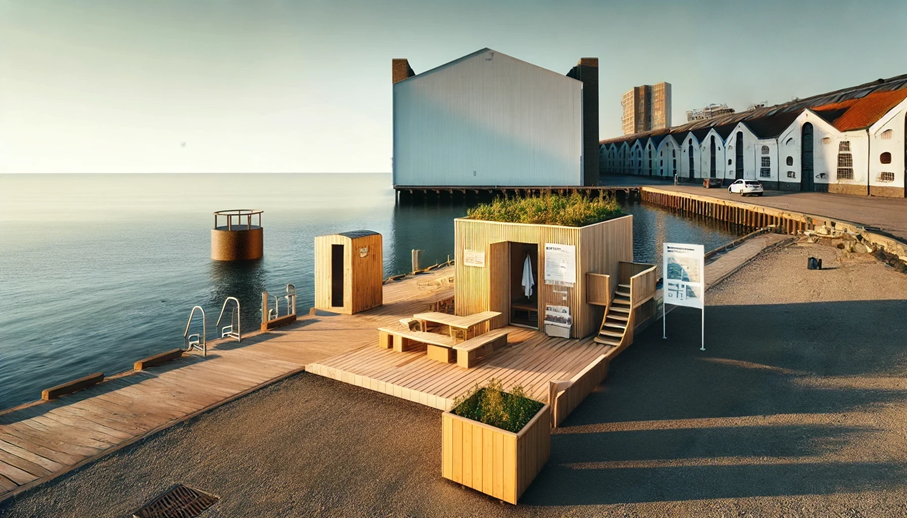
To frame and start the experiment, AI-based prototypes were used to visualise and discuss scenarios before commissioning a solution provider to build the sauna and the surroundings.
The Municipality worked together with members of the Vordingborg Harbor Bath Association on the experiment. They have been talking about the possibility of establishing a harbour bath at Sydhavnen more permanently. As the primary stakeholders, they were very early defined as “The coalition of the willing” – the drivers of the project, both now and in the future. This ensured continuity beyond the temporary experiment and strengthened the link between experimentation and long-term urban development.
The citizen-driven, experimental initiative “Social Sauna” has proven to be a success, demonstrating the potential for a social meeting place in Vordingborg Southern Harbor. The number of members of the Harbor Bath Association rose, and the sauna was used many times during the experiment. The project exemplifies how a temporary initiative can contribute to urban development, strengthen community ties, and activate public spaces in new ways.
The evaluation of the experiment highlighted the need to enhance the sauna’s capacity, improve physical facilities, and develop a sustainable operational model.
The Vordingborg Harbor Bath is currently exploring the possibility of scaling the project by applying for funds, as it will stop benefiting from the City and European funding. To be more permanent, the project will have to strengthen partnerships, clarify governance and operational models, and to secure permissions from relevant authorities like the Coastal Directorate.
The goal is to establish a permanent sauna in the urban space setting by the harbour front, while waiting for a bigger harbour bath across the waterway. In close collaboration with the municipality of Vordingborg, the first objective is to obtain permission from the Coastal Directorate to build the sauna in connection with the existing fishing bridge for the users and visitors to be able to bathe safely in the waterway.
The experiment thus functions as a stepping stone within a broader strategic transformation of the port-city interface.
In images